

An AI Officer, also called a Chief AI Officer or CAIO, is a senior specialist responsible for how artificial intelligence is governed and used across an organisation. As AI reaches into everyday operations and regulation tightens, more organisations are asking if they need one.
 This page explains what an AI Officer does, if the role is legally required, and how to tell if your organisation would benefit from one.
IS AN AI OFFICER LEGALLY REQUIRED?
In most cases, there’s no legal requirement to appoint someone with the specific job title of AI Officer.
However, the EU AI Act does introduce clear obligations around AI risk, governance, transparency, and human oversight. If your organisation operates in the EU, or provides AI systems used in the EU, you will need to understand your role in the AI supply chain, such as provider, deployer or other operator, and whether you’re using AI systems classed as high-risk.
High-risk AI systems carry specific obligations, including risk management, technical documentation, human oversight, monitoring and incident reporting. Following the EU’s Digital Omnibus on AI, these rules are expected to apply from 2 December 2027 for stand-alone high-risk systems and 2 August 2028 for AI systems built into regulated products as safety components.
Read more about the EU AI Act amendments here
The cost of unclear AI ownership
Penalties under the EU AI Act can be significant, depending on the the nature and severity of the violation. For serious breaches concerning high-risk AI governance failure, fines can reach up to €15 million or 3% of global annual turnover.
While the law may not require an AI Officer or a CAIO by name, regulators increasingly expect you to show clear accountability for how AI is used. Appointing an AI Officer is an effective way to show this and ensure oversight and control.
WHAT DOES AN AI OFFICER DO IN PRACTICE?
An AI Officer gives your organisation the leadership and structure needed to use AI safely, responsibly, and in line with regulation. Their role usually includes:
- Mapping where AI is used and classifying each system by risk
- Setting AI policies and governance standards for teams to follow
- Managing AI risks such as bias, accuracy, security and misuse
- Reviewing AI suppliers and tools before they’re adopted
- Overseeing AI risk assessments before new systems go live
- Making sure AI decisions are explainable to customers, employees and regulators
- Reporting AI risks to senior leadership and holding single-point accountability
AI OFFICER VS DPO: WHAT’S THE DIFFERENCE?
They’re closely related, but they’re not the same job, and they shouldn’t sit with the same person.
A Data Protection Officer (DPO) is responsible for how personal data is handled and protected under the GDPR and other privacy laws. The role has a statutory definition and is mandatory in certain circumstances.
An AI Officer or Chief AI Officer is responsible for the broader governance of AI, including model risk, bias, transparency, accountability and regulatory alignment. This extends to AI systems that don’t process personal data but may still carry significant risk for the organisation, individuals, or society.
Where AI relies on personal data, the roles overlap. Without coordination, you risk gaps or duplication. Keeping the roles separate but aligned gives you clear accountability across both.
For a deeper comparison, see our guide: AI Officer vs DPO: What’s the difference?
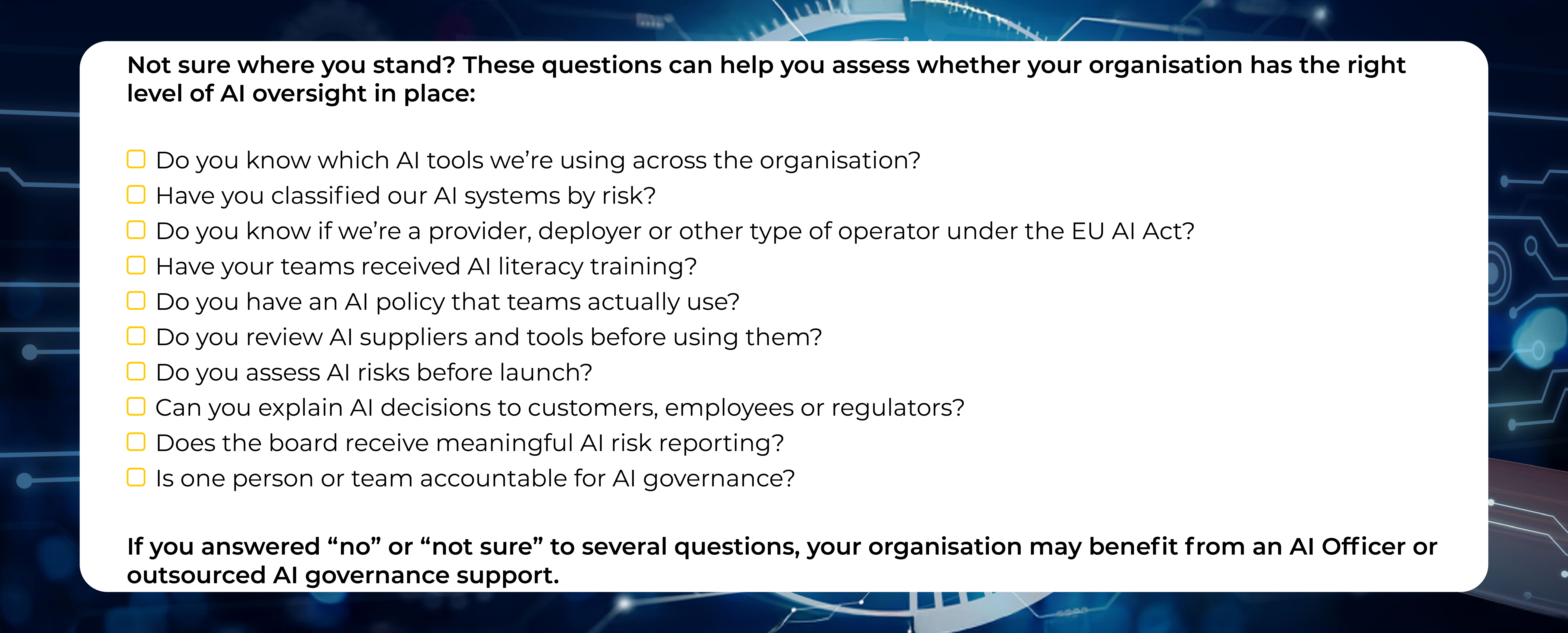
SELF-ASSESSMENT CHECKLIST: DO YOU NEED AN AI OFFICER?
The DPO Centre supports over 1,000 organisations worldwide with their data protection and AI governance. Contact us to see how we can help yours.
Enquire Today
Fill in your details below and we’ll get back to you as soon as possible